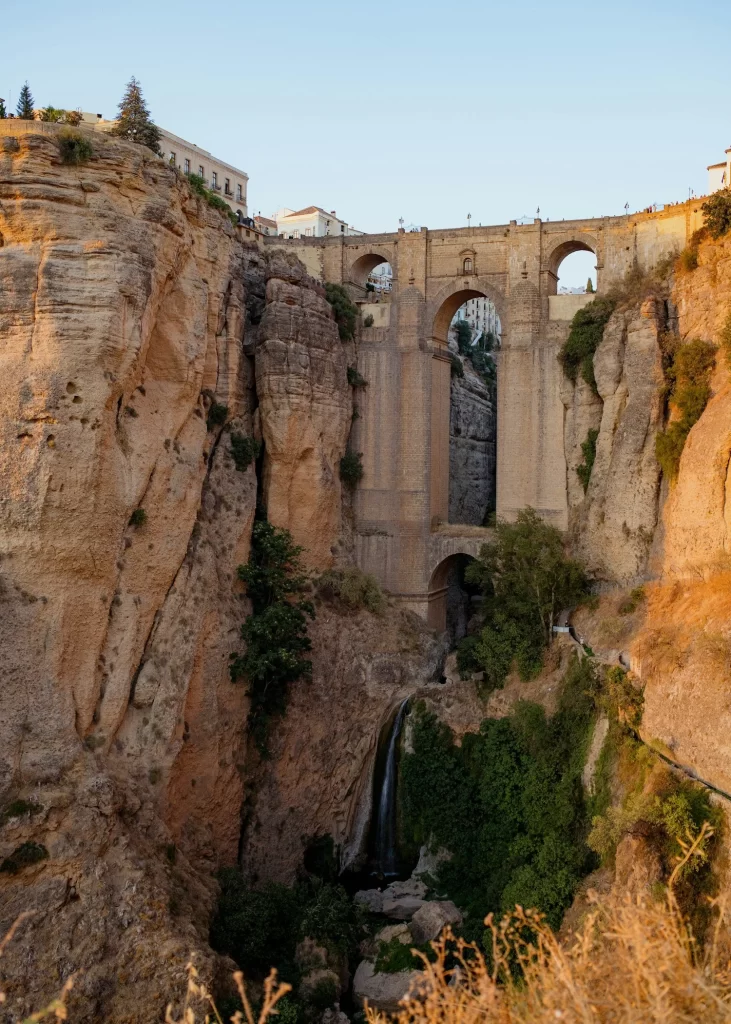
Few places in southern Spain deliver that wow feeling quite like Ronda – a dramatic clifftop town split by a deep gorge, packed with layers of Moorish and Christian history, and crowned by one of Andalusia’s most iconic bridges. If you’re staying at Hotel Molino del Santo, visiting Ronda is one of the easiest (and most rewarding) activities to add to your itinerary.
In this guide, we’ll share what to see, where to wander, and how to make the most of your visit – whether you want a relaxed half-day in town or a full cultural deep-dive.
Why visit Ronda while staying at Molino del Santo?
Molino del Santo is all about switching off – unplugging from the noise and reconnecting with nature, great food, and the people you’re travelling with.
Ronda complements that perfectly: it’s a compact town that’s easy to explore on foot, but rich enough in viewpoints, monuments, and local flavour to fill a full day.
It’s also close and convenient. Ronda is around 14km away, with journeys commonly taking around 20 minutes depending on your route/transport.
Ronda’s headline moment: the Puente Nuevo and El Tajo Gorge
Your first stop (and the one you’ll remember most) is the Puente Nuevo – Ronda’s “New Bridge” – spanning the gorge carved by the Guadalevín River. The town’s defining gorge, El Tajo, drops around 120 metres and is described as the city’s identifying mark in the official practical city guide.
The Puente Nuevo was built between 1751 and 1793, and Ronda also has two other historic crossings: the Puente Viejo (17th century) and the Puente Romano (from Moorish times).
Local tip: Start your route in the Alameda del Tajo, a beautiful park with breathtaking views. If you want a different view from below, a newly built path suspended on the canyon walls – Desfiladero del Tajo.
What to see in Ronda Old Town (La Ciudad)
Ronda’s historic centre feels intimate and atmospheric – whitewashed lanes, historic gates, and unexpected viewpoints. The city guide highlights how the Moors enriched Ronda with walls and city gates (including Puerta de Almocábar) and that Moorish baths by the river still preserve their main halls.
Add these to your walking route:
Moorish baths (Baños Árabes)
One of the best-preserved remnants of Al-Andalus in the area – set lower down near the river.
Santa María la Mayor
A landmark church built over an ancient mosque, reflecting Ronda’s layered past.
Historic mansions and museums
Ronda’s guide points to standout cultural stops including the Casa del Rey Moro and multiple historic houses/mansions that now house exhibitions, historical context, manicured gardens and beautiful views.
Ronda and bullfighting heritage: Real Maestranza de Ronda
Even if bullfighting isn’t your thing, the Real Maestranza bullring is a major part of Ronda’s story. Ronda historically is a cradle of bullfighting, built in 1785 and is famously associated with the Romero legacy.
The architecture is striking, and the on-site museum provides cultural context that helps you understand why the bullring matters here.
A scenic extra: Acinipo (Roman Ronda)
If you’re up for a short excursion beyond the centre, the archaeological site of Acinipo is a memorable add-on. The practical city guide notes it’s about 20 kilometres from Ronda and features a Roman theatre with seats carved from rock.
This is ideal if you want to pair “classic Ronda” with a quieter historical site and big open views.
How to plan your day: a simple, stress-free itinerary
Here are two easy ways to shape your visit:
Option A: Half-day highlights (4–5 hours)
- Arrive and head straight to Puente Nuevo
- Stroll the viewpoints and gorge edges
- Wander through the Old Town
- Stop for coffee/tapas (check out our Tapas trail here), then return to the hotel
Option B: Full-day slow travel (6–8 hours)
- Morning: Puente Nuevo + Old Town
- Lunch: relaxed Andalusian meal – we like El Morabito for views or Tragatá for more contemporary food
- Afternoon: Moorish Baths + Casa del Rey Moro
- Optional golden-hour drink at Hotel Catalonia rooftop or Hotel Reina Victoria terrace
Maps of Ronda are available at reception.
Getting to Ronda from Hotel Molino del Santo
Ronda is an easy outing from the hotel’s mountain setting, and you’ve got options depending on how you like to travel.
- By car/taxi: commonly around 14 km / ~20 minutes.
- By train: services operate between Benaojan-Montejaque and Ronda, and journey times are often around the low-to-mid 20-minute range on direct services (varies by timetable).
Back at Molino del Santo: round off the day the best way
After a day of viewpoints, history, and exploring, coming back to Molino del Santo is part of the experience—quiet mountain air, a slower pace, and the feeling you’ve “done” Ronda without having to stay in the busy centre.